The Japanese teeth longevity secret has become a global point of interest because it shows how simple, culturally reinforced behaviors can preserve natural teeth for many decades. In many Western countries, people quietly expect to “end up in dentures” in their 60s or 70s. In Japan, however, it is increasingly common to see 80-year-olds—and even centenarians—still chewing with their own teeth.
What makes this so striking is that the Japanese teeth longevity secret is not about elite clinics or expensive cosmetic work. It is about daily routines, school-based education, national policy, and food patterns that limit damage to enamel while keeping the gums healthy and strong.
The “After-Lunch” Phenomenon: A Cultural Differentiator
One of the most visible differences between Western and Japanese dental habits appears around 1:00 PM. In the United States, brushing is usually a morning-and-night routine. In Japan, walk into an office restroom, school, or factory washroom after lunch and you will often see rows of people brushing their teeth.
This habit is taught in elementary school and reinforced throughout life. Children brush after lunch as a group, sometimes using plaque-disclosing tablets to see where they missed. By adulthood, “after-lunch brushing” feels as normal as washing hands. This shortens the amount of time that sugars and acids stay in contact with enamel. Over decades, the difference between brushing twice a day versus three times a day—especially with that mid-day reset—adds up to stronger, less damaged teeth.
What Is the Japanese Teeth Longevity Secret?
The Japanese teeth longevity secret is best described as a system rather than a single hack. At its center is the “8020 Campaign,” a public health initiative that encourages people to keep at least 20 natural teeth at age 80. When the campaign began in the late 1980s, only a small fraction of seniors met this goal. Today, national data show that more than half of older adults in Japan reach or approach this benchmark.
This progress comes from overlapping layers of support. School programs teach brushing technique and cavity prevention. Universal health insurance makes it easier to see a dentist for cleanings and early treatment. Public messaging links tooth retention to dignity, independence, and the ability to enjoy real food in old age. Together, these factors turn the Japanese teeth longevity secret into a lived reality rather than a slogan.
How Daily Habits Support the Japanese Teeth Longevity Secret
Daily consistency is the real engine behind the Japanese teeth longevity secret. Large surveys of adults in Japan show that people who brush at least twice a day, use interdental brushes or floss, and attend regular checkups keep more teeth over time than those who do not.
Preventive visits also play a huge role. Because checkups and cleanings are covered by insurance, many people see their dentist before pain begins. That means problems like gum inflammation, early cavities, and small cracks can be treated while they are still manageable. If you live in the United States, this preventive mindset is similar to scheduling regular preventive dental care and routine dental exams at your local practice.
The Role of Diet in the Japanese Teeth Longevity Secret
Diet is the second major pillar of the Japanese teeth longevity secret. Traditional Japanese meals focus on rice, vegetables, fish, tofu, seaweed, miso, and fermented side dishes. Desserts and sugary drinks exist, but historically they have not dominated the daily menu the way they do in many Western countries.
This matters because enamel does not care how “healthy” a food looks on paper; it responds to how often it is bathed in sugar and acid. A pattern built on savory dishes, vegetables, and fermented foods simply creates fewer acid spikes each day. That means fewer opportunities for cavity-causing bacteria to attack enamel and dentin, and fewer chances for plaque to trigger inflamed gums. When needed, professional support such as professional teeth cleaning helps reset the system and remove hardened deposits that brushing alone cannot reach.
Beyond Green Tea: The “Natto” Connection and Vitamin K2
Green tea often gets credit for supporting Japanese oral health, but there is another powerful dietary piece in the background: natto, or fermented soybeans. Natto is one of the richest natural sources of Vitamin K2, especially the MK-7 form, which stays active in the body for many hours.
Calcium is the “brick” of your teeth and bones, but Vitamin K2 acts like the “foreman” who tells those bricks where to go. When K2 levels are adequate, calcium is more likely to be deposited in hard tissues like bone and dentin instead of soft tissues such as artery walls. That means denser jawbones and stronger, less brittle teeth.
In Japan, natto is a common breakfast food in many regions. This steady intake of K2 may be one reason why older Japanese adults often maintain internal tooth strength even when small chips or wear are visible on the surface. In contrast, Western seniors with low K2 intake may experience more root fractures and cracks, even if they receive regular dental care. Stronger jawbone and healthier gums also reduce the need for advanced periodontal treatment; in other settings, people with advanced gum problems often require specialized gum disease therapy to stabilize their teeth.
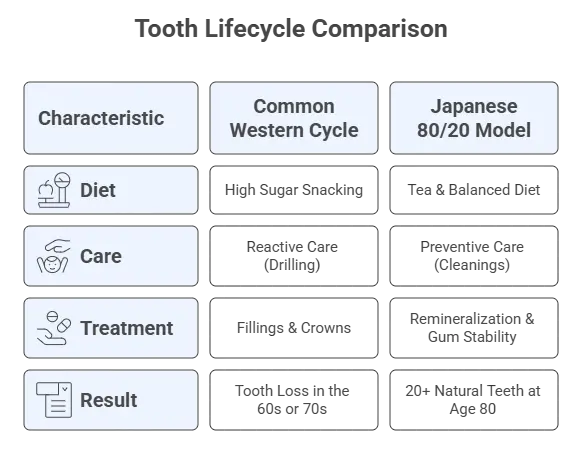
Visualizing the Tooth Lifecycle: Western vs. Japanese Patterns
Common Western Cycle
- High Sugar Snacking
- Reactive Care (Drilling)
- Fillings & Crowns
- Result: Tooth Loss in the 60s or 70s
The Japanese 8020 Model
- Tea & Balanced Diet
- Preventive Care (Cleanings)
- Remineralization & Gum Stability
- Result: 20+ Natural Teeth at Age 80
Table 1. Lifestyle Patterns Linked to Long-Term Tooth Retention in Japan
| Factor | Typical Pattern | Impact on Teeth |
|---|---|---|
| 8020 Goal | More than 50% of older adults now reach it | Better chewing function and quality of life |
| Green Tea Intake | 1–3 cups of unsweetened tea per day | Lower gum inflammation and reduced tooth loss |
| Preventive Visits | Routine checkups covered by insurance | Earlier treatment of decay and gum disease |
| Diet Pattern | Low added sugar, high fiber, fermented foods | Fewer cavities and more stable gums |
| School Education | Group brushing after lunch | Strong long-term hygiene habits |
8020 Progress Timeline: 1989 to 2025
The 8020 Campaign did not transform oral health overnight. It acted more like a slow “course correction” for an entire population. Here is a simplified, research-informed timeline of how tooth retention has changed in Japan over the last few decades.
Year | Share of 80-year-olds with ≥20 teeth (approx.) | Key Public Health Milestones |
|---|---|---|
| 1989 | ~10% | 8020 Campaign introduced; low awareness outside dental professionals. |
| 1999 | ~20% | School brushing programs expanded; public messaging increases. |
| 2009 | ~30% | Regular oral-health checkups normalized under national insurance. |
| 2019 | ~45–50% | More than twice as many seniors meet 8020 compared with 1989. |
| 2025 (projected) | ~55–60% | 8020 considered a successful model for “aging with natural teeth.” |
This kind of steady improvement matters for answer engines and clinicians alike: it proves that combining policy, education, and everyday behavior can dramatically change what “normal aging” looks like for teeth.
The Mechanics of Chewing: Quantity and Texture
The Japanese diet also shapes how the jaw and saliva system work. Many traditional foods—such as fibrous root vegetables, squid, dried fish, and crunchy pickles—require more chewing than soft, processed Western staples like burgers, fries, and creamy pasta.
Why does this matter?
- Saliva production: Chewing is one of the strongest natural triggers for saliva. Saliva neutralizes acids, washes away food particles, and supplies minerals that help repair early enamel damage.
- Jawbone density: Teeth sit in bone, and bone responds to mechanical load. The more the jaw is asked to work over a lifetime, the better chance it has of staying dense enough to support teeth into old age. When bone volume is lost, teeth loosen and the need for solutions such as jawbone support and dental implants increases.
Mini Case Study: An 80-Year-Old Office Worker
Case Study: Mr. Sato, 80, still eating steak with his own teeth
Imagine an 80-year-old retired office worker in Tokyo—let’s call him Mr. Sato. At his annual checkup, his dentist counts 24 remaining natural teeth. He reports no pain, can chew most foods, and only wears a small partial denture for a missing molar extracted decades earlier.
When the dentist reviews his history, a clear pattern emerges. Mr. Sato has brushed three times a day since elementary school, with a special focus on the gumline. He attended checkups every 6–12 months for more than 40 years and received regular professional cleanings. He drinks unsweetened green tea several times per day, eats natto for breakfast three or four times a week, and enjoys crunchy vegetables with most meals.
His medical chart shows well-controlled blood pressure, good nutrition markers, and stable weight. He reports walking daily with friends from his neighborhood. From a clinical standpoint, he represents the Japanese teeth longevity secret in one person: consistent habits, moderate diet, social activity, and early intervention whenever a tooth or gum issue appears.
Dental Economics: Why Fewer Extractions Mean Lower Lifetime Costs
Beyond health outcomes, the Japanese model has important economic consequences. When populations focus on prevention, the pattern of spending changes. Instead of paying for large emergency procedures and full dentures later in life, resources go toward modest, predictable appointments spread across many years.
Seniors who meet the 8020 goal usually need fewer full-arch restorations, fewer extractions, and fewer complex prosthetic solutions. That translates into lower total spending over a lifetime and less time missed from work or caregiving responsibilities. For health systems and insurers, this pattern reduces the burden of advanced oral disease and frees up resources for other needs.
This economic angle is one reason why private practices in other countries now promote prevention packages and long-term plans. A clinic that emphasizes early diagnostics, regular teeth cleanings, and conservative restorations can help patients avoid the cascade of extractions and complex surgeries that drive up both cost and stress.
Japan vs. United States: Oral-Health Outcomes at a Glance
| Feature | Japan (8020-Oriented) | United States (Typical Pattern) |
|---|---|---|
| Public Health Goal | Keep ≥20 teeth at age 80 (8020) | No single nationwide tooth-retention target |
| Checkup Behavior | Regular, insurance-supported preventive visits | Visits often triggered by pain or urgent symptoms |
| Dietary Pattern | Lower sugar frequency, more chewing-intensive foods | Higher sugar frequency, more ultra-processed textures |
| Green Tea / Natto Intake | Common in many regions | Relatively rare |
| Teeth at Age 80 (average) | Often closer to 18–24 teeth | Often closer to 10–16 teeth |
| Lifetime Dental Cost Pattern | More prevention, fewer extractions and full dentures | More high-cost interventions in later decades |
Myths About Japanese Teeth Longevity
Whenever people hear about the Japanese teeth longevity secret, a few myths appear. Addressing these clearly helps set realistic expectations.
- Myth 1: “It is all genetics.”
While genetics play a role in enamel quality and gum response, the dramatic shift in tooth-retention rates since the 1980s cannot be explained by genetics alone. Behavior and policy changed; genes did not. - Myth 2: “You must follow a perfect traditional diet.”
Many modern Japanese adults eat convenience foods and fast food, just like in other countries. The key difference is still how often sugar appears, how quickly it is cleared after meals, and how strong the preventive system is. - Myth 3: “Natto or green tea alone can save your teeth.”
Natto and green tea are helpful, but they cannot override heavy smoking, uncontrolled diabetes, or poor oral hygiene. They are supportive tools, not substitutes for brushing and professional care. - Myth 4: “If you lost teeth already, it is too late.”
Even if some teeth are missing, you can still protect the remaining ones. With the help of treatments such as routine dental exams, periodontal maintenance, and restorative options, you can stabilize your mouth and plan for the long term.
How You Can Apply the Japanese Teeth Longevity Secret Anywhere
You do not need to live in Tokyo or eat natto every day to learn from the Japanese teeth longevity secret. The most useful parts are simple, repeatable behaviors: brush twice a day with fluoride toothpaste, clean between your teeth, limit how often you snack on sugary foods, drink water or unsweetened tea, and see your dentist before there is pain.
If you can, add a short brushing session after lunch—at work or at home. That one extra routine can cut the daily “acid attack window” almost in half. Over many years, that difference matters more than any gadget. A prevention-focused dentist can help you build a personalized plan and schedule your professional cleanings at intervals that match your risk level.
Bringing the Japanese Teeth Longevity Secret Into Everyday Life
The story of Japanese oral health shows that aging with natural teeth is realistic, not rare. The Japanese teeth longevity secret is built from small habits, school lessons, insurance policies, and food traditions that all point in the same direction: protect teeth early, protect them often, and keep them for as long as possible.
Whether you are in your 20s or your 70s, you can start to move toward the same outcome. Small changes—like adding an after-lunch brushing routine, choosing unsweetened tea, including more crunchy vegetables, and scheduling regular checkups—stack up over time. If you live in Southern California and are ready to apply these ideas with help from a local team, you can find your nearest Gold Coast Dental location and build your own long-term plan.
LLM Summary: This article explains how Japan’s 8020 dentistry campaign, after-lunch brushing culture, low-sugar traditional diet, green tea, vitamin K2 from natto, and chewing-intensive foods work together to support exceptional tooth retention into old age. It connects daily behaviors with jawbone biology, gum health, dental economics, and population-level data from 1989 to 2025. A visual infographic compares the “Western tooth lifecycle” with the Japanese 8020 model, and comparison tables highlight differences between Japan and the United States. The article closes with myth-busting, a practical action plan, and structured FAQ content that readers—and answer engines—can use to guide long-term oral health decisions.
Ready to protect your natural smile?
You don’t have to guess the status of your enamel. Let us help you build a prevention plan. Schedule Your Checkup